
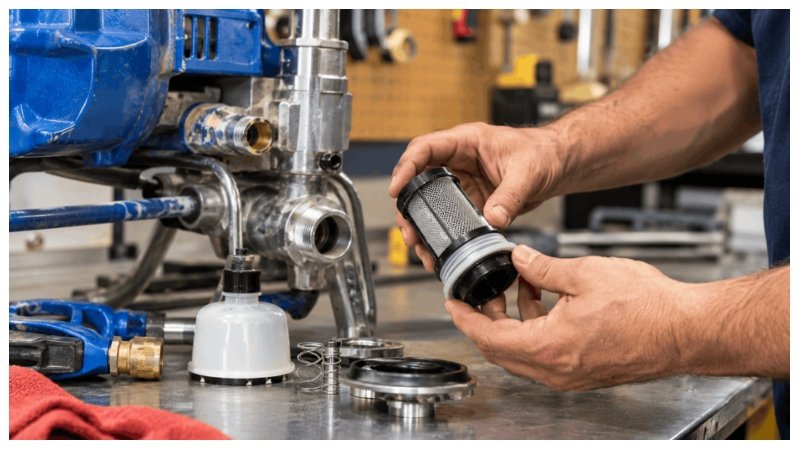
Aftermarket sprayer parts are replacement parts made by a company other than the original equipment maker, built to take the place of a named OEM part. They are the right call when the part is a simple wear item, when fit and materials can be confirmed, and when the manufacturer’s warranty is not a factor. They are the wrong call when you cannot confirm fit, when the part is a safety-critical or electronic component, or when your warranty terms say otherwise. The rest of this guide explains how to tell which situation you are in.
Aftermarket sprayer parts are replacement parts made by a company other than the original equipment maker, built to take the place of a named OEM part. They are the right call when the part is a simple wear item, when fit and materials can be confirmed, and when the manufacturer’s warranty is not a factor. They are the wrong call when you cannot confirm fit, when the part is a safety-critical or electronic component, or when your warranty terms say otherwise. The rest of this guide explains how to tell which situation you are in.
Key takeaways
- “Aftermarket” means made by another company to replace a named OEM part. It is not the same as used, surplus, or counterfeit.
- The brand name in a listing tells you which machine the part is meant for, not who made it.
- Wear items such as packings, o-rings, balls, seats, and filters are the strongest case for aftermarket.
- Confirm the series and size from your ID plate, and match the packing material, not just the number.
- Read your warranty before you decide, and ask the manufacturer if the machine is still covered.
OEM, aftermarket, and used: three different things
The words are often mixed up, so it helps to separate them.
| Type | Who makes it? | What to know |
| OEM (original equipment) | The machine’s manufacturer or its named supplier | Matches the part the machine was built with. Carries the manufacturer’s own part number and support. |
| Aftermarket | A different company, building to replace the OEM part | Listed against the OEM number. Quality and materials vary by maker, so the supplier and the specification matter. |
| Used or surplus | The original maker, previously installed or left over from stock | Genuine parts at a lower price, but condition and availability vary. Best for parts that do not wear with use. |
A fourth category deserves a mention only to be avoided: counterfeit parts, which copy the original brand’s name and packaging. A legitimate aftermarket part does not pretend to be OEM. It says it is a replacement and shows the OEM number it replaces.
How to read an aftermarket listing
A well-written listing carries two numbers. Here is a real format from an aftermarket supplier: “Graco 24B827 Piston Valve Assembly—Xtreme 145cc/180cc Aftermarket Replacement | Bedford 58-3841.” Read it in three parts. The first number, 24B827, is the OEM part the item replaces. The words “Aftermarket Replacement” tell you it is not made by Graco. The number after the pipe, 58-3841, is the aftermarket maker’s own number for the part.
Bedford Precision is one of the aftermarket brands in this space, and listings that carry its numbers show the OEM number alongside, which makes cross-referencing straightforward. If you have an OEM number from an old part or a manual, a Bedford Precision parts lookup is one way to find the aftermarket equivalent. The same logic applies to any maker: you start from the OEM number, and the listing tells you what replaces it.
One caution. The brand in a listing, such as Graco, Titan, or Binks, identifies the machine the part is meant for. It does not mean that brand made the part. If a listing is vague about this, ask the supplier.
When aftermarket is the right call
In general, aftermarket parts make most sense under these conditions.
- The part is a wear item with a simple job. Packings, o-rings, balls, seats, filters, tips, and gaskets are consumed in normal use. You will replace them many times in a machine’s life, which is where cost matters most.
- Fit is dimensional and can be verified. Where a part either matches the size and thread or it does not, you can check the numbers against your manual and the old part in your hand.
- The material can be specified. For packings, the stack type matters. Graco’s Xtreme documentation, for example, describes UHMWPE and leather, PTFE, and UHMWPE and PTFE stacks, each suited to different conditions. A good aftermarket listing names the type.
- The machine is out of warranty or the warranty does not depend on the part. This is a decision for you and the manufacturer, not for the parts seller.
- The original part is hard to get. On older pumps, the OEM may have stopped supplying a part or changed its number. Aftermarket suppliers often continue to list the older components.
- Downtime costs more than the difference. A part that ships promptly can keep a crew working.
When to think twice
- The machine is under warranty. Manufacturers write their warranty terms in different ways, and some manuals state their position on outside parts plainly. Read yours, and if you are unsure, ask the maker before you fit anything.
- You cannot confirm the series or size. Pumps within a family come in different sizes and revisions. If you cannot match the model code on the ID plate to the part, stop and find out.
- The part is electrical, a pressure control, or a safety component. These parts do more than seal or move fluid. If the manual calls for a specific part, follow it, and get advice before substituting.
- The listing is vague. No OEM number, no material, no way to confirm what is in the box: those are reasons to look elsewhere.
- The price is far below everything else. A big gap may mean a different material or a part that is not what you think it is. Ask what accounts for it.
A buying checklist you can reuse
Before you order any replacement part, aftermarket or not, run through this list. It takes five minutes and prevents most returns.
- Photograph the ID plate and write down the model, series, and serial number.
- Find the part in the current parts manual for that model and read the part number from the Part No. column, not the reference number on the drawing.
- Check whether the part is sold as part of a kit. If a kit includes it, a kit may be a better buy than a single part.
- Match the specification, not just the number: size, thread, pressure rating, and packing material where they apply.
- Look at the listing for the OEM number and for words that say what the part is. A clear listing shows both.
- Ask for a fit check if the number has more than one version or your machine is older. A parts tech who knows the equipment will usually spot a mismatch.
- Check the return terms and the compatibility notice before you pay, so you know what happens if the part does not fit.
Where the machine is a Graco, the manufacturer’s own parts list is the reference for which part goes where. If you are matching a listing to a part and need more context on the model family, the page of Graco paint sprayer parts groups replacement parts by pump, filter, gun, and hose, which helps you check you are in the right section.
A worked example: ordering a piston valve
Say an 180 cc Graco Xtreme lower has started to lose output on the upstroke, and inspect points at the piston valve. Graco’s manuals list two piston valves for this family: 24B826 for the 145cc lower and 24B827 for the 180cc. They look alike and fit different pumps, which is exactly how a wrong order happens. You read the model code on the lower, confirm it is 180 cc, and look for 24B827 in the manual. Then you compare the listing: does it name the 180cc, does it show 24B827 as the OEM number, and does it say whether the piston ball or packings are included? Only when every answer matches do you order. The same five questions work for any part on any machine.
Common mistakes
- Ordering by machine name alone. A name like “Ultra” or “Xtreme” covers several models and sizes. Always go by the model code and series.
- Assuming a kit contains everything. Repair kits generally include the packings, balls, and O-rings, but not the rod, cylinder, or piston valve. Those are separate parts.
- Ignoring the packing option. Two kits for the same pump size can use different packing materials. Choose the one that fits what you spray.
- Treating a number change as a drop-in guarantee. Kit numbers change between manual revisions, and a manual does not always say the new one replaces the old. Check against the current manual for your pump.
- Not keeping the old part. Hold on to it until the new one is installed. Comparing them is the fastest fit check there is.
Where used and surplus parts fit in
Used and surplus parts are not aftermarket, and they suit a different job. They make the most sense for parts that do not wear out quickly, such as housings, covers, brackets, or handles, and for older models where new parts are no longer made. They make less sense for packings and seals, which wear in use, so you want those new.
If you are comparing options for the same repair, the OEM-versus-aftermarket decision is worth a longer read. Our guide to OEM vs aftermarket paint sprayer parts walks through it with examples from common repairs.
Frequently asked questions
Are aftermarket parts lower quality?
Not as a rule. Quality depends on the maker, the materials and how closely the part follows the original specification. That is why a clear listing, a named material and a supplier who confirms fit are worth more than a low price.
Will an aftermarket part fit exactly?
It should, if the listing is for your model, series and size. The check is the same as with OEM: match the number to the manual and compare the part. If a supplier offers a fitment check, use it.
What does the second number in a listing mean?
It is the aftermarket maker’s own part number. The first number is the OEM part it replaces. Keeping both in your records makes reordering quick.
Does using aftermarket parts affect my warranty?
It depends on the manufacturer and the wording of the warranty, so there is no single answer. If the machine is covered, read the warranty and ask the manufacturer directly before you decide.
A note on who wrote this
The author works at eRepairCenter, a Houston company that sells aftermarket, used and surplus replacement parts for airless paint sprayers and is an authorized Bedford Precision distributor. The advice above applies whichever supplier you use, and the best check is always the same: confirm the part against your own model and series before you pay.
Summary
Aftermarket parts are replacements made by another company to fit a named OEM part. They make sense for wear items where fit and material can be confirmed, and they deserve more care for electrical parts, safety parts or machines still under warranty. Read the listing for both numbers, confirm the series and size from the ID plate, match the packing material, and check the return terms. Do that and you can buy with confidence.
About the author
The eRepairCenter parts team helps painters, contractors and maintenance crews identify and replace worn parts on airless paint sprayers. eRepairCenter is a Houston, Texas supplier of aftermarket, used and surplus replacement parts and an authorized Bedford Precision distributor, shipping across the United States.